

In Part 1, we introduced the Psychosocial Safety Climate Hierarchy of Control (PSC-HOC) framework and its five levels – from senior leadership commitment through to individual worker strategies, supported by a strong communication strategy and insights from a strategic communications consultancy Australia. The framework makes clear that genuine workplace wellbeing requires systemic action rather than individual coping support.
But knowing the framework is one thing. Implementing it is another within a structured internal communications framework.
The shift from wellbeing band-aids to systemic solutions does not happen overnight. It requires honest assessment of where the organisation currently sits, genuine leadership commitment that goes beyond policy statements, and the capability-building and implementation discipline to make change operational at every level of the hierarchy through effective communication strategies in business.
This is Part 2: the practical roadmap for embedding psychological safety into the way work is done in Australian organisations, supported by internal communications consultancy Australia expertise.
At Corporate Crayon, we are a workplace wellbeing strategy consultancy working with Australian organisations to make this shift – from reactive to proactive, from individual to systemic, from aspiration to implementation.
How do Australian organisations implement the PSC-HOC framework in practice?
Implementing the PSC-HOC framework requires five practical steps: starting with an honest assessment across all five levels through surveys, focus groups, and leadership interviews; securing genuine leadership commitment demonstrated through decisions and behaviour, not just statements; targeting the highest leverage points – often at senior leadership or organisational systems levels; building capability throughout the organisation; and measuring what matters with metrics that show real impact rather than just activity.
Key Takeaways:
- Assessment must be honest and multi-method – anonymous surveys, focus groups, and leadership interviews each reveal different dimensions of the current psychosocial safety state
- Genuine leadership commitment means leaders who demonstrate commitment through actions and decisions, not just endorsed policies or approved programmes
- Small shifts at senior leadership or organisational systems levels often create bigger impacts than massive investments in individual resilience
- All five levels require specific action plans – zero tolerance for harmful behaviour (Level 1), transparent reporting systems (Level 2), effective wellbeing conversation training (Level 3), workload review (Level 4), boundary-setting support (Level 5)
- Part 2: practical PSC-HOC implementation
- 5 steps: honest assessment, genuine leadership commitment, target leverage points, build capability, measure what matters
- Small systemic shifts outperform large individual resilience investments
- Goal: thriving, not just surviving
- Corporate Crayon helps Australian organisations make this shift – start your wellbeing transformation
What Implementation Actually Requires
Most Australian organisations that engage with the PSC-HOC framework understand it intellectually within the first conversation. The challenge is implementation – specifically, the gap between leadership endorsement and the operational changes that make it real at every level.
Dr. Chanvi Singh is direct about what genuine implementation requires: it is not about fancy statements – it is about leaders who demonstrate commitment to psychological wellbeing through their actual decisions and actions.
Wellbeing implementation strategy that translates the PSC-HOC framework into specific, sequenced organisational changes – rather than a general aspiration – is what differentiates organisations that adopt the framework theoretically from those that transform their wellbeing outcomes.
Read More About: Workplace Wellbeing Beyond Quick Fixes: The PSC-HOC Framework
Step 1: Start With Honest Assessment
Before interventions are planned, Australian organisations need accurate data about their current psychosocial safety state across all five levels.
Wellbeing assessment tools combining anonymous surveys, qualitative focus groups, and leadership interviews give the three-dimensional picture needed. Each method reveals different things:
- Anonymous surveys – psychological safety to be honest, producing quantitative data about how widespread specific concerns are
- Focus groups – specific language, examples, and texture that surveys cannot capture
- Leadership interviews – what leaders believe about current state, surfacing the gaps between leadership perception and employee experience that are almost always present and always important
The honest assessment phase is not comfortable. It consistently reveals gaps between what leadership believes and what employees experience. But this discomfort is precisely what creates the genuine urgency for change that programmatic wellbeing investment without honest diagnosis cannot generate.
Action Plans Across All Five Levels
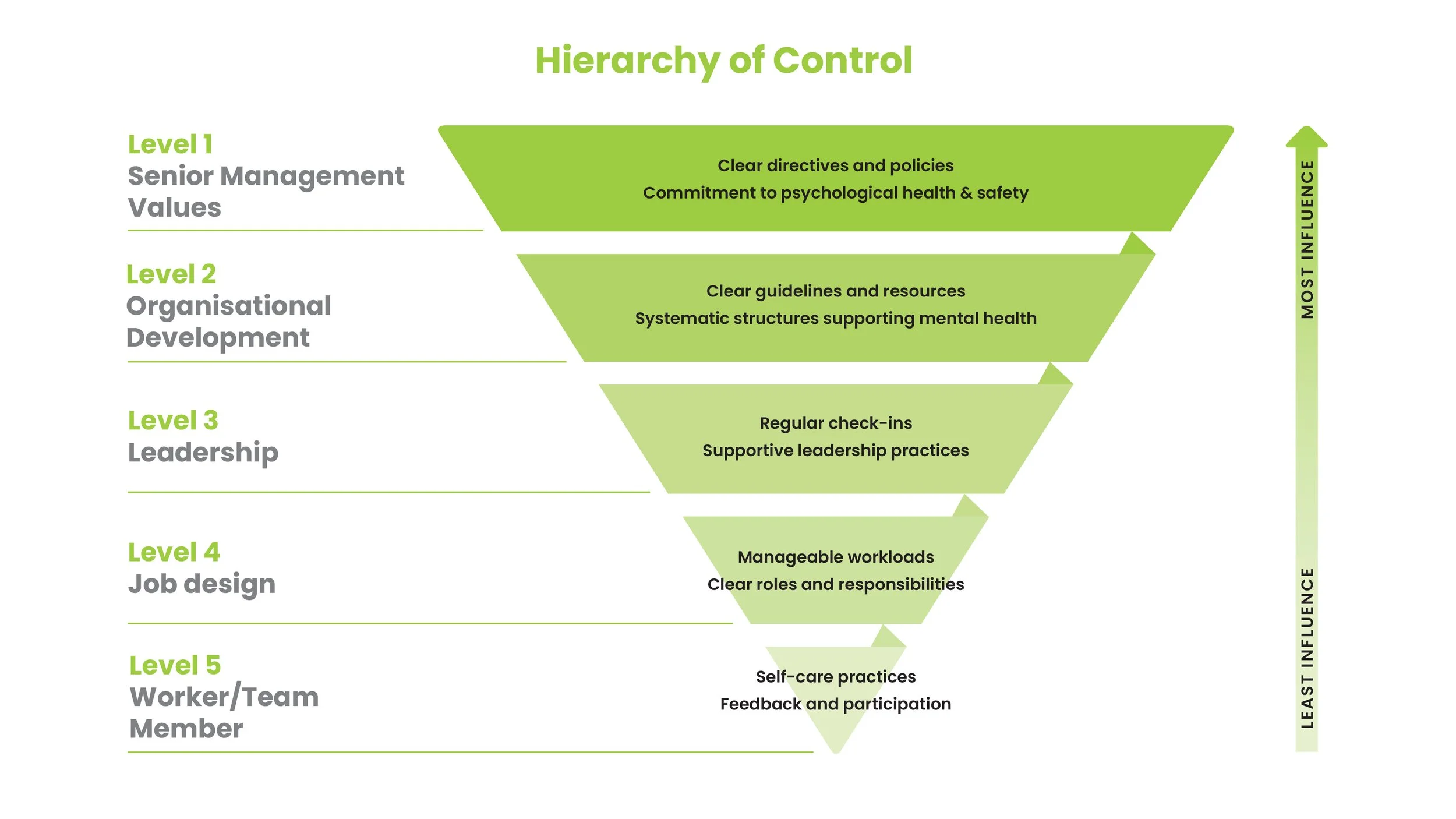
Level 1: Senior Management
Practical Level 1 actions for Australian organisations:
- Develop clear, specific policies on psychological health – concrete commitments with defined accountabilities, not aspirational statements
- Ensure psychological safety metrics are reviewed with the same rigour as financial metrics – in board reports, executive meetings, and leadership performance frameworks
- Allocate meaningful resources to psychological wellbeing – not residual budget after other priorities are funded
Demonstrate zero tolerance for psychologically harmful behaviours – applied consistently regardless of seniority or performance
Level 1 leadership commitment is the foundation that determines whether every other level delivers. Corporate Crayon helps Australian organisations build this commitment authentically. |
Level 2: Organisational Systems
- Create transparent, accessible reporting systems for psychological hazards – so employees can raise concerns without fear of retribution
- Develop manager toolkits for addressing wellbeing issues – practical resources with language and frameworks to act with confidence
- Design onboarding processes that establish psychosocial safety from day one – communicating what the organisation’s commitment to psychological health means in practice
- Implement regular psychosocial risk assessments – building measurement into the operational rhythm, not just annual exercises
Level 3: Leadership Capability
Psychosocial safety communications design that makes wellbeing capability visually clear, practically useful, and genuinely embedded in how managers communicate – rather than producing dense policy documents that sit unread – is what ensures Level 3 investment actually changes daily leadership behaviour.
- Equip leaders with practical skills to identify early warning signs of psychological risk
- Train managers in having effective wellbeing conversations – creating communication capability that transforms concern into support
- Include psychological safety leadership in performance metrics – making it visible and accountable
- Encourage leaders to model sustainable work practices – demonstrating through behaviour that overwork is not the standard
Read More About: Leadership and Employee Engagement: What Inspiring Australian Leaders Do Differently
Level 4: Job Design and Work Environment
- Review workloads to ensure they are genuinely manageable – not just technically possible but sustainably achievable without chronic stress
- Design roles with appropriate autonomy and decision-making authority – genuine agency over the work employees are responsible for
- Build in opportunities for skill development and growth – a structural feature of roles, not an add-on when time permits
- Ensure adequate resources match the demands placed on workers – the most common single source of Level 4 psychological harm in Australian organisations
Level 5: Individual Worker Strategies
- Encourage personal boundary-setting and recovery practices – and make clear through culture and leadership behaviour that these are valued, not penalised
- Promote peer support networks – formal and informal structures giving employees access to support from colleagues who share their context
- Empower workers to speak up about psychological hazards – building team-level psychological safety that makes speaking up genuinely safe
- Support skill development for psychological self-care – practical tools to maintain wellbeing effectively
Making the Shift: From Surviving to Thriving
The practical implementation of the PSC-HOC framework produces an outcome that is qualitatively different from any wellness programme: the shift from workplaces where employees merely survive to workplaces where they genuinely thrive.
Dr. Singh frames this shift clearly: when organisations stop asking how their people can cope better with difficult work environments and start asking how to create environments that enable their people to thrive – that shift changes everything.
For Australian organisations facing talent shortage, psychosocial risk legislation compliance, and sustained performance pressure, this is not a philosophical position. It is the practical competitive advantage that psychologically healthy workplaces produce – lower turnover, stronger engagement, greater innovation, and the organisational resilience to navigate change without the fragility that poor psychosocial safety creates.
How we implement wellbeing change at Corporate Crayon is built on the recognition that implementation without honest assessment produces the wrong interventions, and honest assessment without implementation support produces data that never becomes change.
Corporate Crayon – Psychosocial Safety Implementation Consultancy, Australia
Corporate Crayon is a strategic communications consultancy based in Australia. Working with Dr. Chanvi Singh and our specialist team, we help Australian organisations implement the PSC-HOC framework – from honest assessment through action planning at each of the five levels, leadership capability development, and measurement frameworks that track genuine impact. Our approach combines evidence-based Work and Organisational Psychology with the practical communication and culture strategies that make implementation operational. We partner with Chief People Officers, HR Directors, and People and Culture leaders across Australian organisations.
Conclusion
The shift from individual resilience to systemic responsibility is where sustainable workplace wellbeing improvement happens. The PSC-HOC framework provides the roadmap. Implementation requires honest assessment, genuine leadership commitment, targeted action at the highest leverage points, capability-building at every level, and measurement discipline to track real outcomes.
Australian organisations that make this shift build the psychologically healthy workplaces that attract talent, retain it, and produce the sustained adaptive performance that modern work demands require.
At Corporate Crayon, we help Australian organisations make this shift well. If you want to know more about how we implement wellbeing change, we are ready. Start your wellbeing transformation
FAQs
How do you start implementing the PSC-HOC framework?
Start with honest assessment across all five levels using anonymous surveys, focus groups, and leadership interviews together. This consistently reveals gaps between leadership perception and employee experience – and that discomfort is precisely what creates the genuine urgency for change. Programmatic wellbeing investment without honest diagnosis consistently fails to generate the commitment needed for systemic change.
What does genuine leadership commitment to psychological wellbeing look like?
Genuine commitment is demonstrated through actions and decisions: psychological safety metrics reviewed with the same rigour as financial metrics; zero tolerance for harmful behaviours applied consistently regardless of seniority; meaningful resources allocated to wellbeing – not residual budget; and senior leaders modelling the sustainable work practices they expect of their teams.
What are the most effective Level 2 organisational systems actions?
The most effective Level 2 actions include: transparent reporting systems employees can use without fear of retribution; manager toolkits with practical language for addressing wellbeing concerns; onboarding processes establishing psychosocial safety from day one; and regular psychosocial risk assessments as part of the operational rhythm rather than one-off exercises.
Why do small systemic shifts produce bigger impacts than large resilience investments?
Small systemic shifts at senior leadership or organisational systems levels produce bigger impacts because they change the conditions that produce psychological harm – rather than improving individuals’ capacity to cope with harm the organisation is still creating. When a senior leader genuinely commits to psychological safety and changes their actual behaviour, it changes the experience of every employee they influence directly or indirectly.
What metrics should Australian organisations track for psychosocial safety?
Track metrics showing real impact rather than activity: psychological injury rates and workers’ compensation claims; engagement scores on psychological safety dimensions; voluntary turnover rates and exit themes; absenteeism patterns; and productivity measures tied to wellbeing conditions. The test: would this metric change if wellbeing genuinely improved? Metrics measuring programme participation do not pass this test.
How does Corporate Crayon help with PSC-HOC implementation?
Corporate Crayon works with Australian organisations through the full implementation journey – from honest assessment across all five levels through action planning, leadership capability development, and measurement frameworks. We work in partnership with Dr. Chanvi Singh, combining evidence-based Work and Organisational Psychology with practical communication and culture strategies that make psychosocial safety genuinely operational.


